
We’re not in a bubble… yet

Updated: Aug 5
Over the last couple months, there have been multiple headlines calling the stock market in a bubble, including from prominent business people and investors like Jeff Bezos and Jeffrey Gundlach.
“This (AI) is a kind of industrial bubble.” - Jeff Bezos (Oct 2025)
“(stock market) is least healthy (seen in my career)” - Jeff Gundlach (Nov 2025)
What do we think?
Public stock markets are not in a bubble, yet (but venture capital investment in AI probably is).
Goldman Sachs recently published an identically titled Global Strategy paper. So rather than recreate the proverbial wheel, we are summarizing their research because we agree with it (especially compared to the fear and greed inducing headlines calling the market in a bubble or the opposite, claiming that AI will solve all of humanity’s problems).
There are three key takeaways that we agree with from this paper:
Valuations are high, so expect lower returns
This is not a bubble because profits have kept up with stock prices (unlike during Dot-com / late 1990s)
For now, business fundamentals of the Magnificent 7 are strong, and they are capturing most of the economic gains from early AI investment.
Charts and highlights from the Goldman paper below.
Prices and valuations are high, so expect lower returns.
The chart below from their paper shows that valuations in the US and especially technology are higher than in the rest of the world and high relative to history in the US.

But some of this is justified because US companies are more profitable (higher ROE) than non-US companies as shown in this second chart. Hence, no bubble.

Fundamentals, like sales and earnings, have mostly supported the rise in stock prices.
The chart below shows that earnings have grown faster for US tech companies than the rest of the market, hence supporting their faster than average stock price growth as well. Again, no bubble.

So far the incumbents (Magnificent 7) have been the biggest beneficiaries of AI.
At least this is true in public stock markets. And these companies have healthy balance sheets (low or no debt) and generate lots of cash to reinvest into new opportunities (highly profitable). The table below compares the fundamentals of today’s Mag7 to the biggest winners during the Dot-com bubble over 25 years ago.

What are the implications of these market conditions?
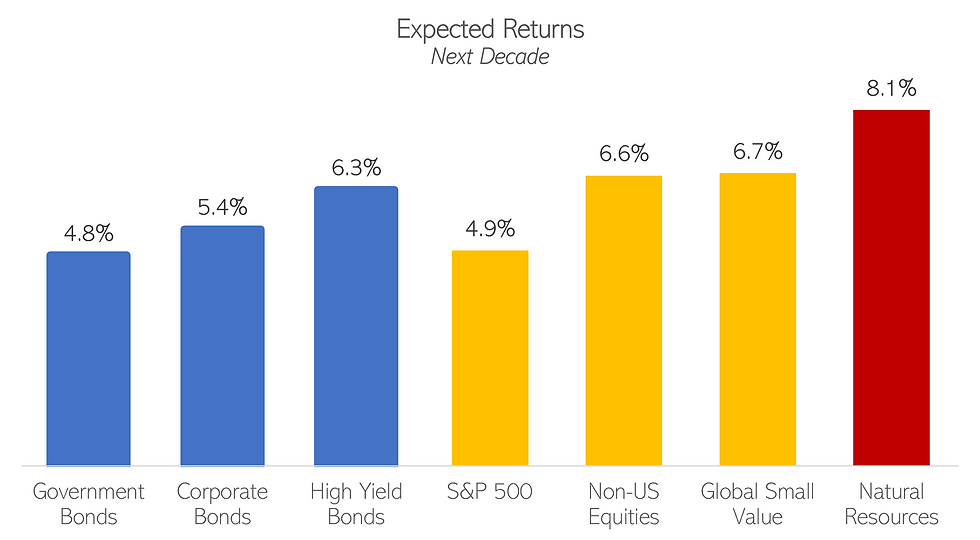
High valuations usually mean lower future returns. In separate research, both Goldman and JPM estimate the long-term returns of US stocks to be ~6.5% from today’s high valuations. With inflation running at around 3%, this is not an especially attractive rate for taking the risk of stocks.
And of course most of these future return forecasts have large margins of error (i.e. they are wrong most of the time). So the solution is to diversify outside of core US stocks. Investors should hold non-US stocks because their valuations are lower and expected returns higher. They should hold bonds to protect against downturns in the economy and the stock market. And they should hold inflation protecting assets like natural resources and TIPS in the event of an additional inflation surprise.
DISCLOSURES: The information contained herein is the property of Greenline Partners, LLC and is circulated for information and educational purposes only. There is no consideration given for the specific investment needs, objectives or tolerances of any of the recipients. Additionally, Greenline's actual investment positions may, and often will, vary from its conclusions discussed herein based upon any number of factors, such as client investment restrictions, portfolio rebalancing and transaction costs, among others. Reasonable people may disagree about a variety of factors discussed in this document, including, but not limited to, key macroeconomic factors, the types of investments expected to perform well during periods in which certain key economic factors are dominant, risk factors and various assumptions used. Recipients should consult their own advisors, including tax advisors, before making any investment decision. This report is not an offer to sell or the solicitation of an offer to buy the securities or instruments mentioned. No part of this document or its subject matter may be reproduced, disseminated, or disclosed without the prior written approval of Greenline Partners, LLC.


Comments