
2026 Midyear Markets Update

Updated: Sep 3
We manage diversified portfolios designed to deliver growth under a wide range of market conditions. However, we also know that all asset classes are vulnerable to losses when there are economic shocks and valuations become expensive. This midyear outlook examines current valuations across the major asset classes that make up our portfolios.
Valuations Point to Modest Future Returns
Valuations, like Price-to-Earnings (P/E) ratios, are a primary driver of long-term returns, alongside whatever unexpected market surprises occur along the way.
The table below compares the forward P/E ratio (based on expected earnings) for major equity markets against their 20-year average and their 90th percentile (which we use as a threshold to indicate bubble territory).
Asset Class | Current P/E | 20yr Average | 90th Percentile |
S&P 500 | 22 | 18 | 23 |
Non-US Stocks | 16 | 15 | 17 |
Small Cap Value | 15 | 12 | 15 |
Emerging Markets | 13 | 13 | 16 |
Source: Bloomberg, Greenline Partners analysis. Small cap value based on Ken French Data Library.
Currently, valuations range from near historical averages to slightly above, but none are in bubble territory.
These valuations inform our estimate of expected returns as shown in the next chart. Based on our internal analysis, we expect global equities to earn roughly 4% to 6% per year over the next decade. While this represents a modest premium over inflation (currently around 3%), it is a far cry from the double-digit returns S&P 500 investors have grown accustomed to over the last ten years.
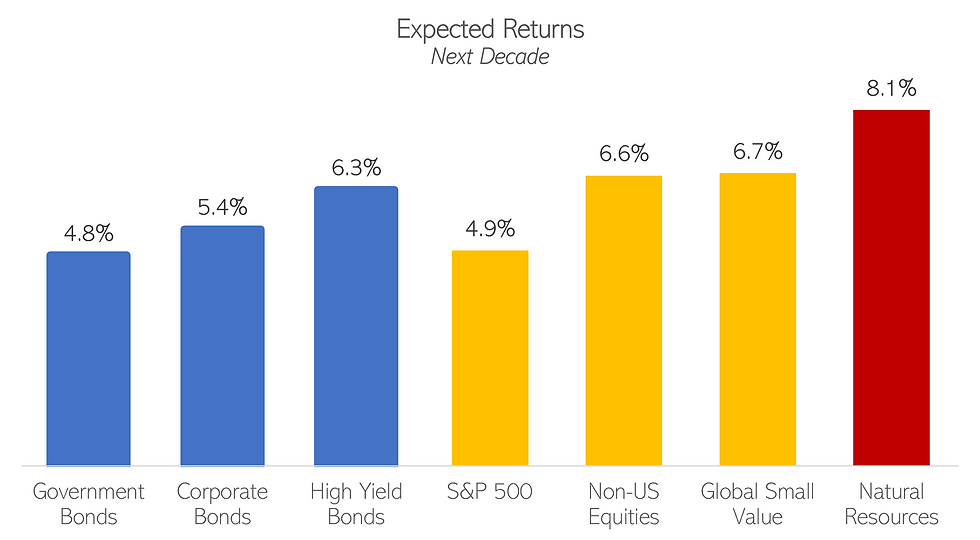
Source: Bloomberg, Greenline Partners analysis
Updated 09/03/2026
The takeaway is equities offer a modest risk premium over bonds and because most equity classes currently offer similar projected returns, diversifying across them is the smartest way to earn a consistent return. This balanced exposure is precisely what we maintain in our client portfolios.
Any market forecast is inherently wrapped in a margin of error. We view a 5% expected return as a range (e.g., 4% to 6%, if not wider). Rather than relying on precise macroeconomic predictions, we focus on identifying the structural risks to these expected returns and building portfolios resilient to them.
Record High Profit Margins: A Key Structural Risk
Instead of trying to read macroeconomic tea leaves, we focus on the fundamental drivers of equity performance: corporate earnings and profit margins.
Globally, profit margins are at record highs as shown in the charts below. This means capital (shareholders) has captured a historically large share of economic gains relative to labor (employees). This dynamic is a key driver behind today’s wealth disparities and populist political environment.

Source: Bloomberg
This rising profit margin has contributed to faster earnings growth as well. The charts below show earnings growth over rolling 5-year periods for US and non-US stocks and both show higher than average growth levels more recently.

Source: Bloomberg
What’s driving these elevated margins?
Structural Shifts (primarily in the US): A structural migration from capital-intensive manufacturing to capital-light software businesses. Additionally, a cultural shift toward share buybacks over dividends has further boosted earnings per share growth.
Cyclical Pressures: Lower corporate taxes and relative wage growth have boosted corporate profits, but this has increasingly become a societal flashpoint. Housing affordability issues and political polarization are direct reactions to this imbalance.
The Role of Technology and AI
How will this resolve? The path of technology and politics is highly unpredictable.
Optimistically, AI and robotics could keep productivity high and maintain or even expand profit margins going forward. However, if this severely displaces labor, higher taxes to support the unemployed could offset corporate gains.
Alternatively, AI could quickly commoditize business processes, drive intense competition and compress profit margins across the board.
To navigate these unpredictable forces, we focus on fundamental diversification by holding diversifying sectors that should benefit from technology driven efficiency improvements, like natural resources, as well as tech forward businesses that are leading the development of AI. Similarly, we hold investments both inside and outside the US. Given valuations in equity markets today, we also hold a healthy allocation to fixed income to diversify equities and to provide income given current yields.
Conclusion
We have intentionally spent little time hyping the AI boom. While its long-term impact seems likely to be profound, its near-term path remains highly uncertain.
At today's valuations, equities no longer offer a healthy premium over bonds, pricing in an outperformance of just 2% or less annually. The biggest wildcard for equities is whether record-high corporate profit margins can persist in a climate of growing global populism.
We prepare for these unknowns not by guessing the future, but through disciplined diversification and valuation mindfulness. While we cannot eliminate volatility, we believe this philosophy remains the most reliable way to protect and grow wealth.
Appendix: How could the US dollar impact global markets?
Many macroeconomists argue that the US dollar is unsustainably high. We see a more balanced picture: relative to other major currencies, the dollar is trading right at its 50-year average.

Source: Bloomberg
While the dollar no longer appears expensive relative to other fiat currencies, it faces competing forces that could trigger future volatility:
Supports for Dollar Strength | Drags on Dollar Strength |
Strong US economic growth | Large US budget deficit |
Attractive domestic investment opportunities | Unpredictable trade policies |
Relatively high interest rates and managed inflation | Sticky inflation above Fed targets |
Because predicting which of these forces will dominate is incredibly difficult, we believe maintaining international diversification is the most prudent defense against sudden currency swings.
DISCLOSURES: The information contained herein is the property of Greenline Partners LLC and is circulated for information and educational purposes only. There is no consideration given for the specific investment needs, objectives or tolerances of any of the recipients. Additionally, Greenline's actual investment positions may, and often will, vary from its conclusions discussed herein based upon any number of factors, such as client investment restrictions, portfolio rebalancing and transaction costs, among others. Reasonable people may disagree about a variety of factors discussed in this document, including, but not limited to, key macroeconomic factors, the types of investments expected to perform well during periods in which certain key economic factors are dominant, risk factors and various assumptions used. The scenario analysis presented is illustrative, is based on certain assumptions, and is not intended to predict or project future results. Recipients should consult their own advisors, including tax advisors, before making any investment decision. This report is not an offer to sell or the solicitation of an offer to buy the securities or instruments mentioned. No part of this document or its subject matter may be reproduced, disseminated, or disclosed without the prior written approval of Greenline Partners LLC. The scenario analysis presented is illustrative, is based on simplified assumptions, and is not intended to predict or project future results.


Comments